3 WAYS how to TEACH ROBOTS human skills

Surprising it may sound, but question of robots’ moral standards is with us for centuries and have been present well before first functioning  robot prototype constructed. If you have seen the old Czech movie Emperor’s Baker, Baker’s Emperor (or its American version the Emperor and the Golem) or knows the story of the Golem, has actually encountered first attempts to make robots morally competent. Clay robot has been activated by inserting the magical stone (shaem) into robot’s forehead. From today’s perspective, more interesting that Golem’s clay is the fact that the robots back then acted as good or bad by standards of the man, who activated the Golem. Unfortunately, the story does not recall how this has been achieved. It is even more puzzling because Golems (and other early robots) did not have any senses to observe its surroundings or to adapt to environment.

Fast forward, human kind has moved from legends to reality. We can build (much more elaborate) robots, we can even equip them with all senses that regular human possesses (sight, touch, hearing, smell and taste). However, in question, how to make the robot good or evil by design we are not much further then Golem times. So what methods did we develop as humans to teach the machine what is morally acceptable and what not?

Some readers might get disappointed upon finding out that in programming robots we try to rely on the learning methods that we use to teach ourselves. The supporters of these approaches reason that if we wantGolem to create robots compatible with human kind, we should provide them with comparable education as we receive as humans. Some disillusion rises from opponents reminding that we hope robots to be better/fairer than the bar we, humans, se for them. While, let’s be sincere, our education system still produces abundance of cheaters, violence or human intolerance. Thus, striving for higher moral standards in robots does not seem to unreasonable request in that context. Be it reality or just our dream, these are three ways we now try to educate machines:

I. Mistakes as a path to success

Central Europeans have the right to be proud that one of the ways, which humans pick to teach robots, has started in Slovakia.  Marek Rosa (Slovak founder or gaming start-up KeenSofwareHouse,  decided to devout his full focus to Artificial Intelligence in company named GoodAI.  Marek’s approach uses mentor to build robot’s thinking habits.  Literally, robot’s own mistakes help him get better via loops of tasks served to him from mentor. Robot tries all possible solutions to the problem and those ways leading to desired result are stored into robot’s permanent memory as useful concepts. Mentor’s role is to feed robot with still more and more complicated tasks upon learning the simpler ones. When robot is faced with conditions same to already solved task from past, he acts to deliver the desired result. Marek Rosa foto
This approach probably most closely follows the pattern of human learning: First we learn to detect digits, then to substract and multliply, yet later to solve the set of equations or to describe curve of time-space. The name GoodAI has been chosen to indicate that artificial intelligence trained this way will not feel off the balance by new circumstances. Robot simply selects the solutions that minimizes the damage and if more often facing that new phenomena, over the time it improves the method to ideal resolution of the problem.

II.  When sugar succumbs to whip
Ron Arkin fotoQuite different approach has been selected by  Ron Arkin, American professor of Robotics at Georgia Tech University in USA. Upon his experience he had gained by programming robots for American military, in classic sugar-whip choice he leaves the caloric option aside. His approach builds on simulating emotions in robots. And emotions that are. Arkin let the robot to decide and after the decision he simulates joy or shame in the robot’s system (by assigning black or red points to his solution). So if robot hits the barrier and tries to smash it by force, the teacher stimulates the shame feeling in robot’s memory about the damage caused to the wall. Therefore, next time robot hits the wall, he refrains the solutions that he felt ashamed about in past and prefers solutions that he has been praised about. This approach is essential because robots quickly learn to avoid unacceptable mistakes. In real life these robots will be less blunt in “surprising, never experienced” scenario than the ones trained by first method.

III. Read your robot a fairy tale before sleep

Mark Riedl fotoThe third approach relies on moral standards development that we, humans, receive in the early childhood. Fairy tales and Stories. Mark Riedl, also from Georgia Tech University agrees to Good AI approach. But he reasons that we do not have enough time to teach robot every tiny bit of the intelligence by plethora of trials and fails.

Therefore, Riedl suggests that robot „reads“ great number of stories and analyses human thought and acting into cause-aftermath pairs. If robots during reading of the stories identifies formula that repeats, it stores it into the memory and will try to validate or disprove this rule in next stories to read. Already from legendary movie  „Number five is alive“ (see video) we know that robots can read enormously fast. Hence, this approach of learning can progress much faster than other methods involving human feedback. Robot can this way infer from innocent stories that if humans walk into the restaurant, they sit down and wait for the waitress to take their food orders. Do you find this trivial? Well, then consider robots to be perplexed, why hungry humans do not storm into the restaurant kitchen and cook something for them, as they do at their homes. The advantage of the “fairy tale” approach is that it can train event complex events that are very complicated to construct into try-and-fail attempts used by Marek Rosa.

Together or against each other?

So, what all three methods share in common? Moral standards training of robots cannot rely on preprogramed routines.  Even if we took the effort of rewriting all our moral standards into chains of “If X happens, then do Y“, robot educated by them would be still paralyzed if new circumstances arise. This way trained robots would also be rigid in times with their standards, fully inapt for human dynamics changing. Let’s not forget that not that long-ago women did not have right to vote and it was owner’s legal right to beat his slave on the street.  Proper training of the robot must allow for him to “learn along seeing” new societal norms, same way we teach new customs upon arriving into foreign culture. At the beginning we are a bit cautious and reserved, but after few days we slowly learn not to be elephant in glasshouse. Robot’s training has several advantages to human education. Firstly, if one robot learns all the needed skills, all his next copies get them right away from moment of the construction. What is more, state authorities, can demand that all human facing robots in given country will share common moral standards and compulsory stick to them. The thing that would be so often needed in our human life as well. But that is different fairy tale to read …

OBSESSION WITH PHONE NUMBERS

One of the advantages of working with large (or even Big-) data sets is that you run interesting and often fun research and experiments. I came one of these opportunities when analysing data of one large Slovak corporations with customer count in range of millions. The study was organized around customer telephone numbers and has arrived upon interesting insights. After all, you better see for yourself:

Are Slovaks obsessed with mobile telephone numbers?!

Dataset comprised of all telephone numbers of the company’s customer base. All of the underlying customers have been retail persons, so now common prefixes of phone numbers involved, pure random subset of country’s mobile phone book. Slovak mobile numbers are always of +421 xxx yyy yyy format. Therefore, the numbers have been ripped of the international (+421) prefix and following 3 digits xxx (signalling which mobile carrier provided the number) have been scrapped as well. Remaining 6 digits  (yyy yyy) are part of telephone number that customer chooses (or is proposed) upon signing the contract. This was also subject of the study, as last 6 digits is the part that customer can actively influence.

Simple research question was plotted: Do Slovaks have any significant preference for digits when selecting their mobile numbers? While if some number pattern appears more often then it statistically should, it is clear, this option was actively requires by clients. So do we, Slovaks, form any distinct pattern this area?

Don’t be zero. At least at start …

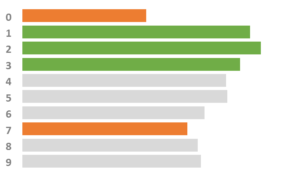
Even though zero is highly regarded among blood groups (can be transferred to any other patient’s veins), this digit is not having a stellar reputation among Slovak phone users. Especially not so in the beginning of the phone number. If you look at what is the frequency of each digit in first position of the telephone number, you clearly see that zero is by far the least popular and Slovaks seem to have some kind of ZERO (and SEVEN) phobia. ON the contrary, 1,2 and 3 seem to be among the most wanted digits to start your telephone number.

graf použitia prvej cifry

The feature gets even more anecdotal, if you understand that we “fear“ this 0’s and 7’s just in first position of the number. If you look at incidence of the each digit on 2nd to 6th place within the numbers the phobia is all of the sudden away. What is more, 0 appears to be quite popular in latter part of the number

NUMBERS_other_digits

 Favourite digit? Yes, but diferent in every age

If also possible positions of given digit taken into account, Slovaks crave for having the 2’s represented in number at most. (At least one digit 2 has been selected into their number by 49%). Therefore, if you meet at least 4 people for family lunch, and everybody writes down his/her telephone number on paper, you can shine with a magic trick claiming that the figure 2 is present at least twice on the papers.

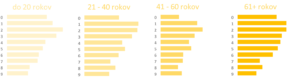
Interestingly the least popular digit in Slovak telephone numbers is digit 9. In phone numbers of our fellow residents the 9’s appear by 10% less often then above mentioned 2’s. What is more striking that these digits preference is not consistent across age groups and some age groups have different preferred digits in their phone number the others. It is clearly documented by digit preference by age clusters:

obľúbené cifry v mobilnom čísle podľa veku klienta

The tendency towards loving “2” and “3” appears to be prevalent across generations. But teenagers find ZERO much more cool than for mid-agers, where “0” is the least liked digit. Older generations tend to prefer “5” (may there be a connotation to Number 5 alive movie?), but younger telephonists are more than lax about it. Interesting trend that all age groups come to agreement is significant lower usage of “7”, “8” and “9.”

Mobile number as status symbol. How badly do Slovaks crave for “nice” number?

You might or might nor remember (based on your age), but when mobile phones have been introduced in mid 90’s of previous century, there was strong demand for fetching nice numbers. This number show-off has sprang out fact that in socialist time, the telephone numbers have been assigned by state Slovak Telecom operator. Having phone line wired to your flat/house was not obvious, so when the line has been installed, you cheered to be in network first place, selecting number was unthinkable. Therefore, upon mobile phones arriving, with you back then being able to pick you own number, hunt for status numbers (e.g. 999 777) has been on rise.

This is obviously one of the reasons that “nice” numbers have been swallowed and they appear not in pool much more frequently then other combinations. Slovaks indeed have an obsession for how their number looks. Just have a look how many Slovaks require their number to have following features:

nice_numbers_EN

In overall, more than half of the Slovak numbers have at least one form of the “nice“ number. That this is not and random phenomena, can be testes with use of Benford’s Law as well. So if Slovak is to choose new phone number, the number better be easy to remember (or at least so was the excuse commonly used for selecting status numbers 😊)

Dates are not cool at all

If people honestly would like to remember their phone numbers, the easiest would be to pick their birth date. Six-digit-form of the phone number actually offers great window of opportunity for that (e.g. 1981 3 6 or 810306 which is also form of socialist time social security number). To my great surprise, this trend has not picked up at all. We have tested the frequency of birthdays in Slovak population and then matched this to list of mobile numbers selected. The research shows that Slovaks do not chose their birthday to appear in phone number. One could object that it can be wedding anniversary or partner’s birthday to appear in the number, which would be nearly impossible to match for test. Nonetheless, the dates in general appear well below average tendency in Slovak mobile numbers.

Nation of Secret service agents

james_bonfIf the might of nations own secret service was determined by how many people in given nation hold agent-like number, Slovakia would be a real intelligence super power. For every 1000 Slovaks there are 41 James Bonds (having 007 as the number ending). Just for the illustration that is 4-times more than as if the people choose numbers randomly. What is interesting here that in there has been much more Bond Girls in the famous spy movies and James Bond is perceived predominantly a “mucho” character, this “spy tendency” is equally distributed among male and female in the Slovak population.
Yes, we are superstitious too

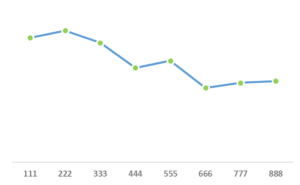
Even though we, Slovaks, tend to pick really nice number, still there is three-digit combination that we try to avoid. Devil number (666) is desirable to have in phone number for less than 0,09% of population. The fear of this demonic digit combination is also evident in comparison of other all-3-same combinations. Reviewing frequency of how often number starts with 111 to 888, it is evident that 666 combination is the least popular, even though digit “6” is rather popular among Slovaks in general.

obava z 666 kobinácie

[just for explanation, using combinations 000 a 999 has been regulated by  mobile operators as they were used for different purposes, so these 2 options have been excluded from comparison]

*********    This is just one of 100+ blogs on how both funny and useful might be data analytics in our lives. Blogs have been published originally on two news portals SME.SK or TREND.SK, but since last year I publish them here on www.themightydata.com. Most of the blogs were originally written for my Slovak fellows, but I constantly work on getting the most interesting ones to get translated into English as well. If you wish to receive updates on new blog posts, do not forget to register into free MightyData community. Members of the community receive also access to presentations and locked private blogs and tutorial videos not visible to general public. If you liked the blog or you have a further question or comment, please drop me an email to info@mocnedata.sk .  *********

This blog post is (some what funny) illustration of how META DATA might have important role in analytics. Meta data are side information on form or other context of the data points. They are not intended (and not expected) to carry the relevant information (e.g. phone number of person is not perceived to be field for predicting his/her behavior), but they often have interesting analytical and predictive implications. There are more illustrations of this phenomenon in my writing, I even coined a term “data underdogs“, as they are surprisingly useful but not expected to be so. I promise to share more of the English versions of blogs on this topic soon.

CRM brainteasers or job interview tasks. Do you dare?

If you search the web or social media, you find plethora of math brainteasers. But if you want to put your grayish matter to test in CRM or Marketing there is not that many of riddles from these areas. You sit candidate for marketing position interview and lack some juicy case study to scan his/her real CRM abilities? There is a hope for you, now.

In past, you might have come across some of the beloved, older round of CRM riddles (I. round,  II. round or III. round , sorry some only in Slovak) After bit of s short break, here we are with 4th round of the cunning CRM mind/benders. Do you dare to get them correct ?


4th Round Of CRM Riddles

4.1 Drier offer

You really had a weird day today. You are manager of CRM team of larger, national electricity utility for households with more than 800.000 retail clients. The VP of Marketing&Sales stopped by your table in the afternoon and passionately talked you through details of new cooperation contract with major electronic appliances chain, just signed by the board of your company. The pilot project of this new cooperation program will be aimed at offering well-discounted cloth drier to your customer base. You are asked for just a little help: to identify a proper target group for this offer. As you company has digital electricity usage meter installed for each customer, you have a 24 month-long history of electricity consumption in hourly readings from each of the customer. On top of that you have a customer profile with basic client data from contract signed between your company and the end/customer. How would you select the clients for mentioned drier offer ?


4.2 Vitamins at the petrol station

You were fed/up with bank analyst job, so you switched a job and now for more than 2 months you already as data analyst in large chain of petrol stations. Your company, operating aloyalty card program, has recently decided to extend the range of assortment offered at their petrol outlets with additional line of unregulated Vitamin products. You are asked to narrow down the selection of clients that should receive (fancy and thus costly) Vitamins introducing direct mail form the central marketing team.  You are still under probabtion period, so you don’t want to spoil this and let your skills shine to superiors. How would you select the customers to be addressed?


4.3 Opening own chain of BIO restaurants

Obviously, more than 9 years in CRM team of the national Telco operator has allowed for loads of bizarre situations. But this made certainly your heart skip a beat. Top management of your Telco company has YESed to launch of new, own chain of BIO FOOD restaurants. You think they must be nuts, but after all its their business to burn the company cash. Or is it? Well would be fine, if only you haven’t been asked to generate list of existing clients that are highly probable to become clients of the soon-to-be restaurant chain. You have extracted all data and behavior insights (from Telco) that you have at disposal on clients had ever passed buy selected locations. How would you pick the correct target group ?


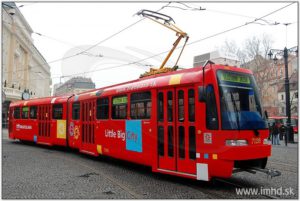
doprava_mhd4.4 Interesting travelers’ behavior

For years you have pulled levers of central insight team for public transport operator in large 1.000.000+ European city (think Prague for instance). Your employer has issued local chip-enabled traveller’s ID that stores client identity and his travel season ticket. All of the vehicles operated by your company are fitted with strong chip readers located at any door of the vehicle. Thus, all clients entering and leaving vehicle are logged into your database. For each of the passenger you have at least 2 years of their travel history and these chip/running clients account for more than 85% of all transport company revenue. Propose 20 cunning client behavior parameters that you can distill from the data at your hand. How creative will you be ?


The solutions of the riddles will be published at TheMighyData blog in few days time. If you don’t want to miss their release, become a free-to-be member of TheMighyData community (who receive update on any new blog on this site).


CRM blogs: What to read in EN from this CRM blog?

Within more than 10 years, that I have been working on CRM, this topic morphed from marginal side stuff into multi-branch issue tree living its own expert life. Before creating THE MIGHTY DATA portal, I wrote articles and blogs for leading Slovak economic weekly TREND. To help you to orientate in what my blog has covered in CRM area in given period, below you can find list of those previous blogs before setting-up THE MIGHTY DATA portal:

Modern CRM trends

Central Europe might be business- and CRM-wise intensive, but still, it makes great sense to seek inspiration in other markets as well. Following group of blogs depict some of the inspirational modern trends in CRM and data usage. Blogs include a few reports from top-notch CRM conferences, I had participated in:

One-to-one marketing is dead! Here comes ONE-TO-ZERO marketing!!!

Already planning for 2016? Get inspired by largest CRM insight event – Part I.

Why are we all so sleepy lately ? – II. part      [DialogKonferansen 2015]

Data underdogs: what they are and how to spot them?

“Ryanair”-like database test: Big Data layers (not only) in Slovakia

What can we learn from Nordic marketers?    [Dialogkonferansen 2014]


Predicting client behavior

Most of us are used to predicting the basic propensities (to buy, to churn, …). How about some more exotic ones? Read-on for some of the less common examples of client behavior prediction:

How to detect “Greek“ tendencies among your clients?


***************   Do you enjoy what you read here? Would you like to get notified on next content from THE MIGHTY DATA? Become FREE member of MIGHTY DATA community.  ******************


CRM in various industries

Different industry, different needs. Though there are some overarching principles of CRM, there is plenty of stuff that has been intensified more in some business segment or the other. Following blogs try illustrate the CRM hypes of individual business industries:

SMS from operator “We are sorry your relationship has crashed.” Like what?!

What can supermarket tell about your health status?

ATM, E-banking, Smart-banking. What’s next?

Going for a holiday? Who earns more on you: Bank, Insurer or Telco company?

Would you be good match for CRM job?

There is no shortage of math riddles on web or within social media. However, if you wish to put your brain to text in marketing or CRM riddles, you don’t find that much of them. Are you hiring a CRM person and you look for real-world puzzle to test his/her CRM skills within the interview? Here are few of those:

Marketing riddles (and solutions to them)

(there are 3 more rounds of similar riddles published in Slovak, which are just in progress to get translated to EN, so expect more, soon)


***************   Do you enjoy what you read here? Would you like to get notified on next content from THE MIGHTY DATA? Become FREE member of MIGHTY DATA community.  ******************


Do you miss any specific topic? Propose your own topic, on which you desire to red more about.

No one can be possibly expert on on of all the CRM areas. Thus I am proud to listen to those who have something reasonable in CRM arena. Feel free to read through views of other CEE CRM experts.


What PETER SAGAN learned about his sprint from Helicopter?

Peter Sagan, the green jersey winner of several Tour de France editions, as well as ruling World and European Champion in cycling has proven plethora times he reads his rivals in the pack. However, there are aspects to his riding that even he himself does not realize. These secrets have been revealed only with help of the helicopter. Matter-of-factly not Helicopter solely, to be precise …

BigData v TdF
BigData v TdF

However well oriented the rider might be, there are facts beyond the human limits of any cyclist, if he is still to deliver some performance himself. Keep in mind that peloton counts up to 200 opponents, so to keep track of only 40 of them is already unthinkable. Even more so,  if you realize dire conditions the racers are usually to face in furnace summer or among buckets of rainfall. Therefore, for already more than 2 years the Tour de France has been invaded by BigData principles.


Big Data senzor
Big Data senzor

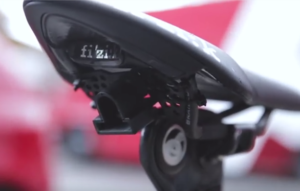
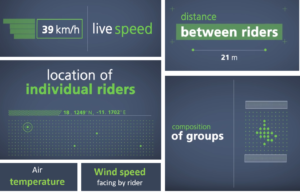
Event organizers established for each race participant to be mandatory equipped with  USB-key-size sensor below bike seat, that tracks and measures large set of performance parameters. Data of all cyclists are collected then in real time during the race and after (literally) eye-blink processing, the aggregated data is at disposal to TV commentators, social media teams or even wide public via means of mobile and tablet apps. The information that can be read from the sensors have been extended from last year’s location and speed valued to measures of air temperature, head win speed, or very actual  slope just being climbed in given moment. Connecting the (racing) dots can depict where in main pack  has been riding for most of the day the prominent stage winner adept or how cooperative in deed were the run-away mates in formed group.  The data imperative is underscored by fact that sensors emit data once every 5 meters of race progress which translates (given the average race speed at Tour de France) into 2 or 3 reading each second of the race!

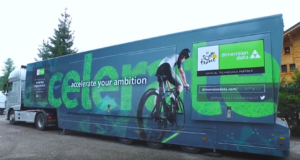
What looks like easy cake in first sight (you stick the emitting sensor below the saddle and just tap the data stream) dturns out to be fairly complex technology-wise. One should not forget that Tour de France stages often cross deserted mountain range peeks or entrenched Alpine valleys, where there is no hope for mobile network signal. What is more, tough weather or hordes of fans along the track would make long distance Big Data collection unreliable and prone to data outage. To prevent his scenarios, emitted signal is collected first by accompanying motorbikes and support vehicles and then via the hoovering helicopter to main Data Dimension truck sitting in finish-line location.  This mobile data lab is designed to provide all the the analytical means  needed to process and generate insights from collected data points in real time. To accommodate for potential power outage risk, Dimension Data (the service provider) maintains two parallel back up teams in different countries ready to take the lead may anything happen with primary lab truck.


So what insights can spectators (and later the racers) find out from this Big Data source? Firstly, the data points reveal unique, so far unseen, distances between any two cyclists any time along the race. Moreover, you can also observe the changes in that TDF KPIsdistances. Therefore, is there is a break-away from peloton, you can clearly see who to what extent was working on swallowing the breaking pack or helping them to escape. These data will glorify even more the role of domestics or disclose to what extent team leaders are enjoying the ride in the larger group. For racers of Peter Sagan style it is essential that data records depict second-by-second the acceleration of any of his rivals within sprints. Peter, thus, can review after stage what acceleration his opponents used and how long can they sustain the peak tempo. In windy stages one can easily read from the data how individual cyclists are coping with the head-wind and “how much pain” does it elude in their muscles (which might be critical for last kilometers of the stage). However, collected data are useful fot he very organizers of the tour as they data sensors measure with great precision the slope of the track and thus can offer correction to less precise measurements from the past.


For folks like us, messing around the data processing, solely the set-up of this Big Data solutions is fascinating enough. Sensors are feeding the databases literally any second of the race with 1000+ new data points that are immediately processed causing less than 1 second delay of data insights compared to actual race development. That is such a data quality, that if you plugged in the photos of racers on their bikes and images of surrounding landscape, Dimension Data would be able to create film of the stage without ever seeing the actual TV broadcast. One should realize that collected data of even greater importance to the teams themselves: If you put cyclist on stationary bike that can simulate track slope and conditions of the day, based on the data replay he could practice again and again the situations that they missed in the real race (remember P. Sagan being always second on the final stage sprints?), until they find a way how to beat them. Cycling practice can improve same way as the chess-players can replay the games to revisit certain positions. Inputs from systems, as that of Dimension Data, will certainly revolutionize (not only) cycling sport. As result those more passionate to win get new means to train to beat the rivals. All you need to do is believe in Mighty data… And then train hard along them.


You have just completed one of the early blogs on this new platform THE MIGHTY DATA. My intention is to build community of like-minded CRM and BigData experts around the globe. If you concur that marketing topics would do with a bit more inspiration or you are just reckless trend spotter,  join our community here.

!! DON’T MISS !! First 100 registered community members of THE MIGHTY DATA will receive gift of TOP 25 CRM presentation from 2016 edition of best CRM,expert conferences. Don’t miss the chance to see what they talked about.

< COMING SOON >

This is personal blog of Filip Vitek, CRM & BigData evangelist and expert. English version of the site is under construction. Come back soon to find new content published!